Jul 3, 2021

[Photography] Female Poses: 21 Posing Ideas to Get You Started Photographing Women

The post Female Poses: 21 Posing Ideas to Get You Started Photographing Women appeared first on Digital Photography School. It was authored by Guest Contributor.

female posing ideas to get you started

Looking for some female poses to use during your next photoshoot? Want to pose women like a pro?

Below, I’ll share 21 of my favorite poses. If you ever run out of ideas, have a creativity rut, or simply need some guidance when shooting female subjects, whip out this article; feel free to use it as your personal posing cheat sheet, even in the middle of a shoot.

(In fact, many pro photographers use a “cheat sheet” technique before and during a photoshoot, so you’ll be in good company!)

Note that the poses in this article are meant as starting points; you can absolutely modify them depending on your model’s comfort level. So before using a complex pose, I’d advise you to talk with your subject, especially if they’re less experienced. Perhaps you can develop an easier version of the pose – that way, you get the shot you’re after, and your model still has a great time.

Without further ado, let’s look at the 21 female poses to take your portraits to the next level!

1. Over the shoulder

female pose idea

Here’s a very simple portrait pose to start with. Have the model turn away from you so that her shoulder is prominent in the frame. Then ask her to look back at the camera.

You can experiment with different angles; try shooting from slightly to the right or left, as well as slightly above her face. This is a classic female pose and one that works great in most situations.

2. Hands on face

hands on face looking forward

If you’re after a more intense, glamour-type image, try this pose. Start by having your model put one hand against her face, while the other hand rests lightly on her jawbone. Ask her to stare straight into the lens.

To take this pose up a notch, have the model play around with her hands. She can try different positions around her head or face. Keep in mind, though: No flat palms, and the hands should only show their sides!

3. Resting on a diagonal

posing on a table

Want to create dynamic portrait compositions? Try incorporating diagonals into your poses, which act as leading lines and can create lots of visual interest.

For instance, find a railing and ask your model to lean against it. If no slanted surfaces are available, you can always create one yourself through a little camera trickery: have your model put her arms on a flat surface, then tilt your camera until you achieve the effect you’re after!

4. Sitting with elbows on knees

sitting with elbows on knees

Here’s a really nice and lovely female pose, where the model sits on a chair, stool, or bench. She should lean forward, elbows on her knees (and the knees should touch one another).

Shoot slightly from above for the most flattering result. You can experiment with different hand positions, but make sure the focus remains on your model’s face.

5. Lying against the ground, hand on head

lying on the ground with hand on head

This one’s pretty easy to pull off, so it works well with less comfortable subjects (assuming they’re comfortable lying on the ground, that is!).

Simply ask your model to lie on her side, facing the camera, with her hand propping up her head. I recommend letting her elbow go past her head. Test out other head turns for a more mysterious vibe.

Also, make sure that you get down low – you should take your shot from ground level or just above. To add a little extra spice, try shooting through a foreground object, such as grass.

6. Lying in the grass, facing forward
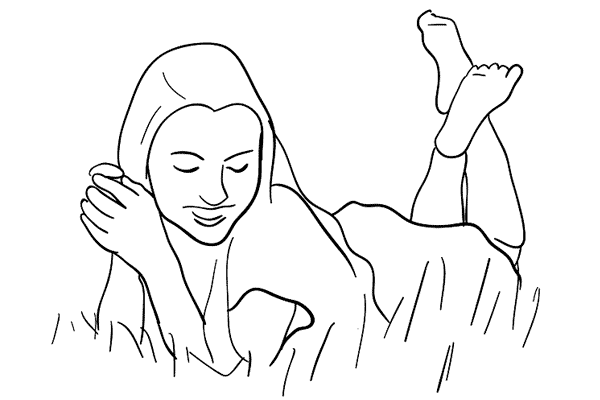
lying in the grass female pose

This pose is a variation of the one I shared above. Instead of asking your model to lie parallel to the camera, ask her to face forward at a slight angle. You want to be able to see her feet.

Ask her to prop herself up using her elbows, though you can experiment with different hand positions (for instance, she can try resting both hands against the ground).

This one works very well outdoors – on the grass, in a wildflower meadow, etc. But as with the previous pose, make sure you get down low so you’re on your subject’s level. That way, you’ll be able to capture a suitably intimate perspective.

7. Lying on back, parallel to the camera

pose for women lying on back

Here’s a basic, easy pose, one that works for beginners, but looks absolutely stunning on pretty much anyone.

Just ask your model to lie on her back, parallel to the camera. Have her turn her head to face you. You can test out different hand positions, though the one shown in the example above is a great starting point. Also, watch her hair – you want it to be arranged nicely – and make sure her head turn looks natural.

Get down and shoot from ground level. Then move gradually around the model while taking photos. You can even try a few from directly overhead for an unusual perspective.

8. Lying on back, perpendicular to the camera

lying on back looking toward camera

This female pose is pretty easy to pull off, even for beginner subjects, but it’s on the glamorous side, so I don’t recommend using it for a standard portrait session.

Here, you ask your subject to lie with her head toward the camera, feet pointed away (though her body should be angled slightly to the side). Try different hand and leg positioning – for instance, ask her to tuck in her legs, lay them flat, etc.

Make sure you get eye contact, and be sure to focus on your model’s eyes!

9. Lying face down, head toward the camera

lying on stomach woman pose idea

Here’s a really lovely pose, one that works well in different settings, no matter the surface. Your model could lie on a bed, on the ground, in the grass, or on a sandy beach; the key is that she is face down, but with her legs up in the air and her head pointed toward the camera.

Make sure to shoot from a very low angle and nail focus on her eyes.

10. Sitting parallel to the camera, hand on knee

sitting with hand on leg

This is another pose that’s easy to do but looks absolutely gorgeous.

Just ask your subject to sit parallel to the camera with one knee up, her weight resting on her back arm. You can experiment with different positions for the other arm/hand, and ask her to tilt her head in different directions: down, toward the camera, away from the camera, and more.

11. Sitting with hands around ankles

sitting with hand on ankle

Here’s another simple and friendly pose for a model sitting on the ground. Ask her to cross one leg while tucking the other under her body. Make sure she faces the camera with her hands around her ankles.

Try different camera angles, though I recommend crouching down to start (eye-level portraits generally look great).

12. Sitting with back arched

lying back with legs extended

If you’re after a more glamorous pose, this is a great option, and it does a nice job of demonstrating a model’s physique.

Ask your subject to sit down parallel to the camera, with her legs pointed forward and her arms behind. Her back should arch slightly upward.

Try different head positions: back, facing slightly forward, facing the camera. And work with different leg positions, too.

If you’re after an especially striking image, position your model in front of the sun, then capture a well-defined silhouette.

13. Standing with hand on hip

hand on hip female pose photography

This is a simple and casual-looking pose, perfect for pretty much any situation.

Ask your model to stand with one hand on her hip. She should shift her weight so her body appears slightly s-shaped, and the other hand can sit in a number of different places: her hair, her face, or across her chest.

Your model can have fun experimenting with different head turns. Also, feel free to test out other hand positions.

14. Standing with hands in pockets

standard pose for women

This one’s amazingly simple but looks super elegant.

Ask your model to start by facing the camera, then have her put one leg out in front and angle her body slightly to the side. She should put her hands in her back pockets (though you can try the front pockets, too).

You can also try different head turns as well as different camera angles for a unique perspective.

15. Leaning forward


posing-photographing-female-models15.png

This one is a glamour classic. Have your model lean slightly forward, while keeping her body generally perpendicular to the camera.

You can try out different hand positions and head turns; you might also consider shooting from different angles.

16. Hands above the head

hands above the head facing forward

Here’s another glamorous, slightly sensual pose. Ask your model to hold her hands above her head (one hand can clasp the other wrist).

You can do this one standing up, though it also works with the model lying down (you just have to find a high vantage point to shoot from).

17. Standing with hands on hips

standing with hands on hips

Full-body poses can be pretty tough, but this one offers a good starting point. Have your model stand with her feet together, one slightly in front of the other, and her weight on one leg.

Her hands will look good on her hips, though you can ask her to put them above her head, in her hair, and more. Also prompt her to change head and eye directions to create interesting variations on this pose.

18. Leaning back against a wall

posing-photographing-female-models18.png

If you’re looking for a more relaxed, casual pose, why not ask your model to lean against an object?

I’d recommend having her put her back against a wall, though she should be standing relatively upright. Ask her to angle her body slightly toward the camera and cross her arms over her chest (though other hand positions can work well, too).

She might also experiment with resting her foot against the wall.

19. Standing in an s-shape

standing in an s-shape pose

The s-shape is a classic women’s pose, though it can be a bit tough to get right, especially when you’re doing full-body portraits.

The posing guidelines are simple: Your model should shift her body into an s-shape (ask her to put her weight on one foot and lean her hip into it), and her hands should be relaxed. You can test out different hand positions – in fact, the next pose on this list offers a nice variation. Also test out different leg positions (for instance, she can raise one leg off the ground, bend her knee, etc.).

20. One hand on the hip, one hand behind the head

standing with hand behind head in a glamorous pose

Here’s an exquisite pose for slightly more glamorous shots, though many variations are possible.

Start by asking your model to shift her weight for an s-curve. She should face the camera, with one hand on her hip and the other behind her head.

For the best posture, ask her to slowly move her hands and constantly twist her body. When you see a good variant, ask her to hold still while you take some pictures. Repeat for a full set.

21. Turned away but looking back over the shoulder

turned away looking over shoulder

Here’s your last pose for photographing women, and it’s absolutely romantic and delicate. It’s popular for glamour and boudoir, especially when your subject has a bare back, though you can always add clothes for a more classical look.

You’ll need to have a cloth of some sort, but anything will work, even a curtain. Ask her to wrap it around her waist and hold it in place while turning her head back over her shoulder. You might consider experimenting with different head positions: her nose parallel to the camera and her eyes down for a more subdued look, or a stronger head turn and clear eye contact for a bolder result.

21 female poses: final words

Well, you now have plenty of female poses to work with, and you’ve hopefully seen at least a couple that you liked.

And remember: each pose is meant to be a starting point, and each one offers endless variations.

So be creative. Adjust the poses as needed.

And you’ll capture some stunning portraits in no time!

Kaspars Grinvalds is a photographer working and living in Riga, Latvia. He is the author of Posing App, where you can find even more poses and posing ideas!

The post Female Poses: 21 Posing Ideas to Get You Started Photographing Women appeared first on Digital Photography School. It was authored by Guest Contributor.


it's from Digital Photography School https://ift.tt/3yl66Qc
via Guest Contributor

Jul 2, 2021

[Photography] The Weekly Photography Challenge – Cold

The post The Weekly Photography Challenge – Cold appeared first on Digital Photography School. It was authored by Sime.

This week our challenge may or may not be a direct result of me being in a house this week with no heating, school holidays for the kids here in Melbourne and the weather has been pretty chilly, so ‘cold’ it is!

The theme is #dPSCold use that hashtag wherever you share your photo. Make sure you take a new photo for this challenge, you don’t learn much by grabbing a photo out of your archive and uploading it 🙂

A cold photography scene

Tips for shooting in the cold or perhaps you could try the frozen bubbles thing

Keeping in mind that ‘cold’ could be many things as it’s applied to photography. A cold colour temperature, a cold scene and that could be many things too… Someone that’s cold, physically, mentally, it’d your story to tell!

Upload your photo into the comments field below this post (look for the little camera icon in the Disqus comments section below this post) and they’ll get embedded for us all to see. Or, if you’d prefer, upload them to your favourite photo-sharing site and leave the link to them.

Weekly Photography Challenge – Looking Up

If you do get stuck, you can contact our friendly (mostly!… ok, well.. after coffee he’s ok!) support guy. He’s on the email support@digital-photography-school.com

The post The Weekly Photography Challenge – Cold appeared first on Digital Photography School. It was authored by Sime.


it's from Digital Photography School https://ift.tt/3Ap8BCD
via Sime

[Photography] Nikon Launches the Z fc, a Film-Inspired Mirrorless Camera

The post Nikon Launches the Z fc, a Film-Inspired Mirrorless Camera appeared first on Digital Photography School. It was authored by Jaymes Dempsey.

Nikon launches the Z fc

Nikon has announced its latest mirrorless camera, the Z fc, which combines top-notch APS-C mirrorless technology, Z-mount compatibility, and a beautiful, retro design.

While the Z fc is anchored firmly in the world of digital photography, the “heritage design,” as Nikon calls it, hearkens back to Nikon’s film cameras – specifically the FM2, an “iconic…SLR film camera released in 1982.”

Nikon explains, “The Z fc is the first Z-series camera to adopt a heritage design, while simultaneously supporting various advanced features. In addition to the enjoyment of shooting great stills and videos, it is designed with particular attention paid to delivering the pride and joy of ownership.”

This isn’t a first for Nikon; back in 2013, Nikon launched the Df, a high-end, full-frame DSLR with a film-inspired design. But unlike the Nikon Df, the Z fc isn’t aimed at advanced enthusiasts. Instead, the Z fc will slot into Nikon’s “entry-level” category, despite its impressive capabilities and a near-$1000 USD price tag.

In fact, the Nikon Z fc closely mirrors Nikon’s current (and only) entry-level mirrorless camera, the Z50. Like the Z50, the Z fc packs a 21 MP APS-C sensor, which strikes a nice balance between resolution and low-light shooting (the Z fc’s sensor likely comes straight from the Z50). The Z fc also features the Z50’s respectable 11 frames-per-second continuous shooting, a decent 2.36M-dot electronic viewfinder, and 4K/30p video.

But the Z fc and the Z50 differ in several important ways. For one, the Z fc includes a fully articulating screen – one that flips out to the side – while the Z50 screen tilts but doesn’t flip. This is a big deal for vloggers; you can mount the Z fc on a tripod, flip out the screen, and monitor the video as you record.

There’s also the retro design, which promises Z fc users an engaged, down-to-earth shooting process. Instead of adjusting shutter speed, ISO, and exposure compensation via your camera’s LCD screen and back dials, you’ll be able to make adjustments via three dedicated top dials. No, it’s not for everyone, but if you’ve shot film and liked the feeling, or if you’re a fan of Fujifilm mirrorless cameras, then the Z fc is certainly worth a look.

Nikon Z fc viewed from above

The Z fc is remarkably compact, making it a perfect option for travel photography, casual walkaround photography, on-the-go photography, and more. At just 14 oz (390 g), you can carry it in a backpack, camera bag, or around your neck for hours on end – especially when used alongside Nikon’s just-announced kit lenses, the 16-50mm f/3.5-6.3 VR and the 28mm f/2.8.

So while the Z fc isn’t the most conventional camera on the market, it should certainly appeal to many photographers. If you’re after a lightweight, compact camera and you appreciate (or don’t mind) the retro design, check out the Z fc. You can currently preorder the body for around $950 USD; expect shipping to begin at the end of July.

Now over to you:

What do you think of the Nikon Z fc? Do you like it? Will you buy it? Were you hoping for a more groundbreaking new camera? Share your thoughts in the comments below!

The post Nikon Launches the Z fc, a Film-Inspired Mirrorless Camera appeared first on Digital Photography School. It was authored by Jaymes Dempsey.


it's from Digital Photography School https://ift.tt/3hwihCG
via Jaymes Dempsey

Jul 1, 2021

[Photography] Creative Phone Photography: 8 Tips for Artistic Mobile Photos

The post Creative Phone Photography: 8 Tips for Artistic Mobile Photos appeared first on Digital Photography School. It was authored by Megan Kennedy.

creative phone photography: 8 tips for artistic images

A phone with a camera is great for photography. But it can be tough to break away from a “snapshot” mindset and start taking images that are truly creative.

In this article, we’ll take a look at some tips to help you capture creative phone photography. Specifically, I’ll share:

  • Key settings to make the most of your phone’s camera
  • Several tips to get you creating unique, artistic compositions
  • A simple secret for surreal-looking phone photos
  • Much more!

So if you’re ready to shoot some creative images, then let’s get started.

1. Shoot in RAW

Familiarizing yourself with the ins and outs of your phone camera is an important way to expand your creative options. Modern camera phones have a surprising range of capabilities that you can use for better photos.

For example, it’s a good idea to shoot in a RAW file format (an option now offered by many native camera apps). While JPEGs are the default format on many phones, they experience a loss in image quality thanks to compression – whereas RAW files are uncompressed and therefore tend to look better.

RAW files also offer greater post-processing versatility. You can adjust colors and tones and recover lost details in a natural, realistic way.

So if you’re after high-quality photos – which allow for extensive enhancement during post-production – then try switching to RAW. (Even if your mobile phone doesn’t offer RAW in its native camera app, you should still be able to find a third-party app that produces high-quality RAW files.)

setting up RAW format on a phone
RAW activated in Pro mode on an Android device.

2. Make the most of Manual mode

As with a conventional camera, Manual mode allows you to take control of your phone’s camera’s settings when capturing a photo. In Manual mode, you can adjust shutter speed, ISO, and white balance – and this additional control allows for greater creative input.

Creative phone photography bokeh

To activate Manual mode (also known as Pro mode) on some devices, open your Camera app and look at the camera mode tray. You should see settings like Timelapse and Panorama, and if you’re lucky, you’ll also have a Pro option.

Simply tap the Pro mode icon, and you’ll be good to go; you’ll gain access to numerous options for adjusting your phone camera’s functionality.

If your phone doesn’t offer a Pro mode, don’t worry. Simply download a third-party app such as ProCamera, Camera+ 2, or Obscura 2. All of these apps feature a Manual mode of sorts, and you can use it to harness your phone camera’s creative potential.

3. Don’t forget about composition!

Over time, plenty of guidelines have been developed to help photographers compose effective images. While none of these guides are inflexible laws, if you’re familiar with some basic compositional concepts, your photos will come a long way.

Of course, compositional knowledge translates to creative phone photography, too! For example, by activating your phone camera’s grid function, you’ll get a useful visual overlay, perfect for positioning key points of interest.

rocks on a beach

Learn about the rule of thirds, leading lines, the rule of space, triangular composition, and more; each of these will be helpful tools that’ll aid in your creative phone photography.

4. Make use of editing apps

I’ve already mentioned how third-party camera apps can give you increased control over your phone camera. But did you know that editing apps offer a whole other world of creativity?

For instance, Snapseed (Android and iOS) is a (free!) Google-owned application with plenty of tools for tweaking images and applying filters. VSCO (Android and iOS) offers some editing functions for free, including artistic, film-like filters. Adobe Lightroom (Android and iOS) supplies image editing tools similar to its desktop counterpart for free, and it can also be upgraded to a paid premium version for additional functionality.

(Unlike VSCO and Snapseed, only the paid version of Lightroom will edit RAW files.)

editing apps for creative phone photography

There are plenty of fun, creative apps available for both iOS and Android devices. Need a retro aesthetic? Afterlight (above, left) provides users with an advanced toolkit to add light leak effects to an image. Want to combine two images into a single photograph? Snapseed (above, right) allows you to quickly and easily merge image layers to create a double-exposure effect.

There are a multitude of apps that suit a huge variety of purposes and capabilities. The fun part is trying them all out!

5. Try different perspectives

One of the great things about creative phone photography is the mobility of a small photographic device. A camera phone isn’t just an accessory; it’s a pocket-sized machine capable of capturing stunning photos.

So take advantage of the size and portability of a phone camera by physically experimenting to create intriguing perspectives. Place your phone close to the ground, try a high angle, or shoot from off to the side. Just make sure to get a non-conventional perspective, and you’re bound to end up with interesting results.

cake from above

6. Go abstract

Also known as experimental, non-objective, or conceptual photography, abstract photography avoids depicting immediately identifiable subject matter.

In fact, creative phone photography and abstraction are a good mix. The accessibility of the phone camera allows you to snap abstract images anywhere, anytime. For instance, when you’re out in a city, you might capture abstract images of puddles on the ground, posters torn off a wall, or reflections in a glass building.

And thanks to readily available editing apps, unique abstract perspectives can be rapidly captured, edited, and shared – or even saved as inspiration for a later shoot with a dedicated camera.

abstract creative phone photo

7. Photograph details

If you have your phone in your pocket all the time – and let’s face it, most of us do! – you’ll be ready to capture even the smallest occurrences at a moment’s notice.

Even when it’s tough to find inspiration, focusing on the details that shape an everyday environment can make for beautiful photos. Try activating your phone’s close-up or macro function, then get close to a subject. You can even purchase little lenses that attach to your phone for close-up photography. A small tripod or a sturdy surface can help keep the camera phone steady.

black and white creative images

8. Experiment!

It may sound obvious, but doing great phone photography can take a little experimentation. Many people assume (due to the advanced and accessible nature of phone camera technology) that every shot will be successful.

But in reality, practice and experimentation are the keys to effective creative phone camera photography. Familiarize yourself with your phone camera’s capabilities and make time to shoot. The more you experiment, the better your images will turn out.

experimental phone photo of a blurry road

Creative phone photography tips: conclusion

Phone photography is a great way to create stunning photos, especially if you want to be artistic without investing in a heavy camera.

Plus, with such a huge variety of apps available, doing creative phone photography has become a much more streamlined process.

There is an old saying: “The best camera is the one you have with you.” And while this might not always be the case, if you take advantage of your phone camera, you can create some truly outstanding images!

Now over to you:

Have you done a lot of phone photography? How do you like it? Which of these tips do you plan to use first? Share your thoughts in the comments below!

The post Creative Phone Photography: 8 Tips for Artistic Mobile Photos appeared first on Digital Photography School. It was authored by Megan Kennedy.


it's from Digital Photography School https://ift.tt/3walv4r
via Megan Kennedy